Walk into any Neapolitan pizzeria and the first thing you notice is the dome: an open mouth facing the dining room, a pizzaiolo turning each pizza with a small peel, and a crust that puffs up in seconds. The shape was refined over centuries in Naples to bake a pizza in about a minute.
Italian manufacturers have now brought the same principle to fully electric dome pizza ovens. They keep the round chamber, the vault and the refractory deck, but replace the fire with electronically controlled heating elements.
What does the dome actually change? Do you need one to make great Neapolitan pizza? And when is a dome oven the right choice for a commercial kitchen? Here is what you need to know.
What is a dome pizza oven?
A dome pizza oven has a round baking chamber topped by a curved vault. The pizza bakes on a refractory stone deck, in the middle of a space that stores heat and sends it back.
This is the traditional shape of the Neapolitan wood-fired oven. In the electric version, heating elements sit in the vault and under the deck, and the chamber is lined with refractory brick or ceramic to recreate the thermal mass of a masonry oven.
What the dome brings to Neapolitan baking
A Neapolitan pizza bakes in 60 to 90 seconds at around 430 to 500 °C (800 to 930 °F). In that short window, heat has to reach the pizza from below and from above at the same time. If the deck does all the work, the base burns before the crust has risen.
The dome answers that need in several ways:
- The vault radiates heat towards the centre. Its curve reflects heat back onto the pizza, which receives intense radiant heat from above.
- Heat spreads through a round space, with no corners.
- The refractory mass stores energy and releases it with every pizza.
- The mouth stays open. The pizzaiolo watches the bake and turns the pizza without opening a door, just as with a wood-fired oven.
What really matters is the balance between heat from the deck and heat from above. A dome is one way to achieve it. It is not the only one.
Do you need a dome for authentic Neapolitan pizza?
No. Other electric ovens reach the same balance with a differently shaped chamber.
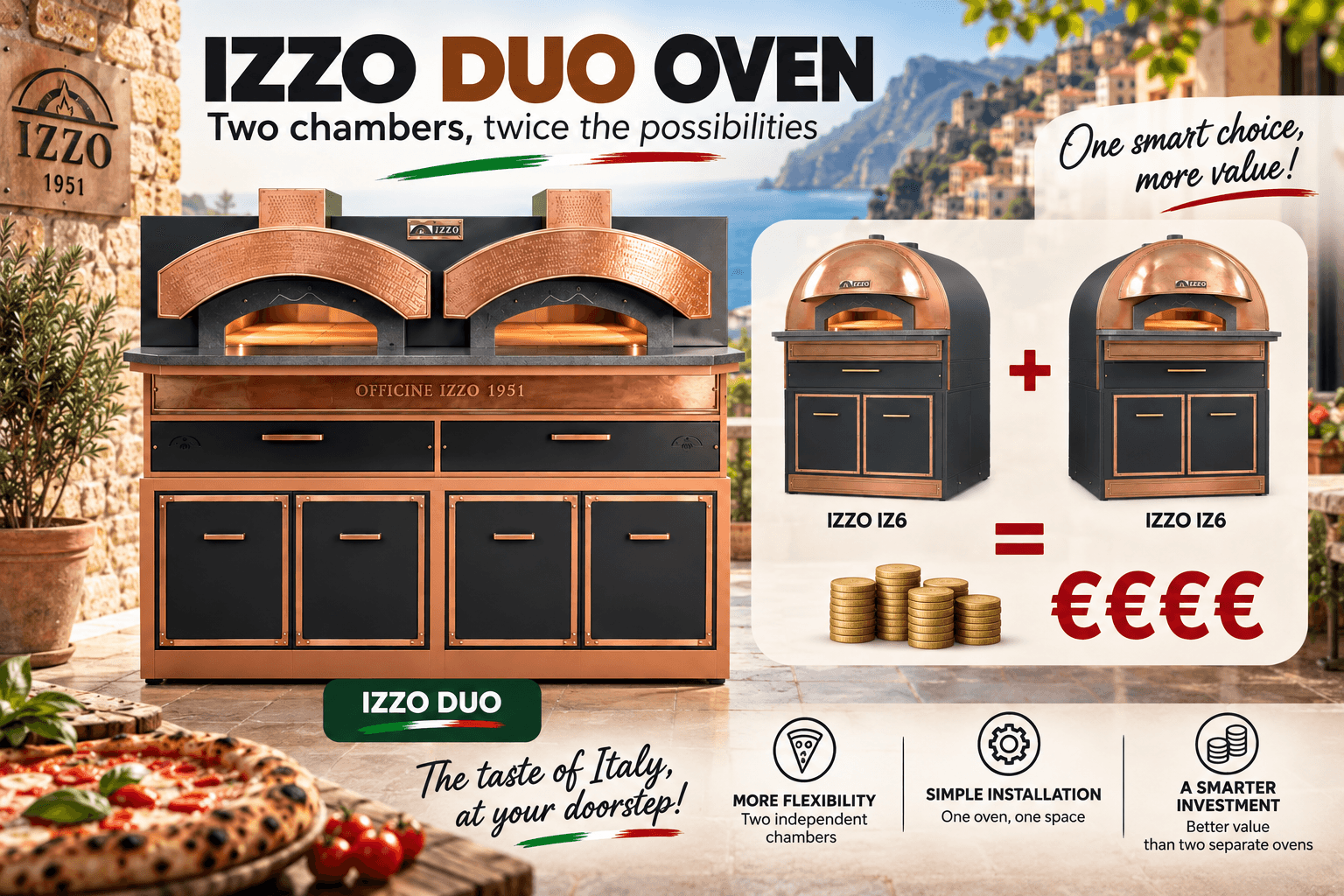
The IZZO Izzonapoletano series is a good example. Under its copper outer dome, the baking chamber is rectangular, with a deck made of 4 cm thick biscotto di Sorrento and a ceiling also made of refractory material. The low ceiling sits close to the pizza and plays the role of the vault: it sends intense heat onto the top while the deck bakes the base without scorching it. The Izzo works at 440–460 °C (825–860 °F) with the mouth open, exactly the way you would work at a wood-fired oven.
The shape of the chamber is a design choice, not a requirement. Great Neapolitan pizza comes from an oven that is genuinely built for this bake: a high and stable temperature, the right deck, enough top heat and a fast recovery between pizzas.
Dome oven, low-chamber Neapolitan oven or deck oven: how to choose?
Commercial electric pizza ovens fall into three broad families:
- Dome ovens (OEM Dome, Roto Dome, Zanolli AVGVSTO): round chamber, open mouth, fixed or rotating deck. Ideal if you want the technique and look of a traditional Neapolitan oven, or high capacity with a rotating deck.
- Low-chamber Neapolitan ovens (IZZO Izzonapoletano): rectangular chamber, biscotto ceiling and deck, open mouth. They deliver authentic Neapolitan baking in a more compact footprint, with models from 2 to 9 pizzas.
- Standard deck ovens: rectangular chambers behind a door that usually run at lower temperatures. Very versatile for New York-style, pan pizza or bread, but not designed for 90-second Neapolitan baking.
For a Neapolitan pizzeria, the real choice is between the first two families, depending on available space, the capacity you need, how your pizzaiolo likes to work and the atmosphere you want in the dining room.
Refractory, Sorrento biscotto, copper: the materials that matter
The chamber and vault are lined with refractory brick or ceramic. The more thermal mass the oven has, the better it holds its heat from one pizza to the next.
The deck is the most critical part. The most demanding Neapolitan ovens use biscotto di Sorrento, an air-dried and fired clay brick traditionally used in the wood-fired ovens of Naples. Its porosity lets it bake the base without scorching it, even at very high temperatures.
Copper is an exterior finish. On the Izzo, the copper dome is hand-worked by craftsmen and gives the oven the look of the great Neapolitan ovens, while the baking itself is done by the biscotto inside.
Fixed deck or rotating deck?
In a traditional dome oven, the deck is fixed and the pizzaiolo turns the pizza with a peel so each side faces the heat.
More and more electric dome ovens now offer a rotating deck. The refractory deck turns slowly and moves each pizza past the hottest areas of the chamber, which brings real benefits:
- a more consistent bake from one pizza to the next;
- less handling for the pizzaiolo;
- higher output at peak times, with several pizzas baking at once;
- faster training for less experienced staff.
Rotation speed is usually set from the control panel, and some models can even reverse the direction of rotation.
A fixed deck remains the choice of pizzaioli who want to keep the traditional technique and full control over every pizza.
How much power does an electric dome oven need?
An electric dome oven that works at 500 °C needs serious power. Depending on capacity, the connected load ranges from about 14 kW for a 6-pizza oven to nearly 28 kW for a large rotating-deck model.
Actual consumption during service is much lower than the connected load, because the elements do not run continuously once the oven is hot. It typically sits between 7 and 16 kWh depending on the model.
Before ordering, check:
- the electrical supply available on site (three-phase in most cases);
- the weight of the oven and the load capacity of the floor;
- the size of the entrance and the route to the final position;
- the extraction hood above the oven mouth.
Compared with a wood-fired oven, an electric oven removes the need for wood storage, ash handling and a chimney flue, which makes it much easier to install in many city-centre premises.
Which electric dome ovens are best for a pizzeria?
If you go for a dome, several Italian manufacturers make electric ovens that genuinely reproduce its shape and behaviour.
The OEM Dome is a fixed-deck dome oven that reaches 530 °C (986 °F). Its biscotto deck and refractory stone vault give it strong thermal inertia. It bakes 7 pizzas of 35 cm (14 in), and top and bottom heat can each be set from 0 to 100%.
The OEM Roto Dome Touch combines the dome with a rotating refractory deck (biscotto available as an option). It also reaches 530 °C and comes in two sizes: 104 cm for 7 pizzas and 140 cm for 14 pizzas of 30 cm (12 in). Rotation speed and direction are controlled from the touch screen.
The Zanolli AVGVSTO is an electric dome oven that reaches 500 °C (930 °F), with a chamber fully lined in refractory ceramic. Its patented Air Trap System® creates an air barrier in front of the mouth to reduce heat loss. It is available with a fixed deck (6 or 9 pizzas of 33 cm) or with a 130 cm rotating deck for 12 pizzas of 30 cm.
If you would rather have Neapolitan baking in a more compact format, the IZZO Izzonapoletano comes in 2, 4, 6 and 9-pizza versions (33 cm / 13 in), starting at €7,500.
To pick the right size, start from your real output at peak hours. Our guide on which pizza oven capacity to choose for your production volume walks you through the calculation.
Dome or not: what really makes great Neapolitan pizza
A well-designed electric dome oven makes excellent Neapolitan pizza. So does a low-chamber Neapolitan oven like the Izzo. In both cases, working temperature, the deck, top heat, refractory mass and recovery between pizzas make the difference, far more than the shape of the chamber.
A dome is mostly a choice of workflow and atmosphere: an oven on show, the traditional technique, a rotating deck and high capacity. To go further, read our article Can you make authentic Neapolitan pizza in an electric oven?
Still deciding? You can configure your Dome, your Roto Dome or your Izzo online and get a free quote within 24 hours. We deliver across Europe and internationally.
FAQ
What is a dome pizza oven?
It is an oven with a round baking chamber and a curved vault. The dome reflects heat onto the pizza, which bakes both from the deck and from radiant heat above, just like in a traditional Neapolitan wood-fired oven.
Are there fully electric dome pizza ovens?
Yes. Italian manufacturers such as OEM and Zanolli make electric dome ovens that reach 500 to 530 °C, with heating elements in the vault and under the deck and a refractory-lined chamber.
Do you need a dome oven to make Neapolitan pizza?
No. What matters is the balance between heat from the deck and heat from above. Low-chamber ovens such as the IZZO Izzonapoletano, with a biscotto di Sorrento ceiling and deck, achieve authentic Neapolitan baking at 440–460 °C with the mouth open.
Should I choose a fixed deck or a rotating deck?
A fixed deck keeps the traditional pizzaiolo technique. A rotating deck gives a more consistent bake, less handling and higher output during service, which makes it a strong choice for high-volume pizzerias.
How much power does an electric dome pizza oven need?
Depending on size, the connected load ranges from about 14 kW to 28 kW, usually on a three-phase supply. Actual consumption during service is lower, typically between 7 and 16 kWh.